

Some events are planned. Others are grown.
Rooted in Resilience: Building Black Health, Wealth, and Legacy in Asheville was grown. It grew from circles of women who began meeting in November 2024, in the raw aftermath of Hurricane Helene, simply to hold space for one another. The Asheville Women's Support Group did not set out to plan a conference. They set out to heal. But healing, when it is done in community, has a way of expanding. What began as gatherings of grief and grace became a vision: a day where Asheville's Black community could come together not only to recover what the storm took, but to claim what has always been theirs — health, wealth, and legacy.
On May 16, 2026, that vision filled the historic YMI Cultural Center — the oldest African American cultural center in the nation.
The Day at a Glance
From 9:30 AM to 2:00 PM that Saturday, the YMI Cultural Center at 39 S. Market Street filled with local leaders, residents, elders, young people, and partners from across the region. Admission was free, a light lunch was shared, and the program moved through an opening ceremony, three panel conversations, open audience discussion, and a vendor marketplace of more than two dozen Black-owned and community-aligned businesses and organizations.
A Sacred Venue, A Deliberate Choice
There was nothing accidental about holding this convening at the YMI Cultural Center. Commissioned in 1892 and sustained for more than a century by Asheville's Black community, the YMI has been a gathering place, a marketplace, a library, and a sanctuary through segregation, urban renewal, and now disaster recovery. To talk about cultural preservation inside walls that are cultural preservation gave the day a weight no rented ballroom could match. As The Urban News wrote in its feature on the event, holding the program at the YMI "has deep meaning, given that this beautiful venue is the oldest African American Cultural Center in the nation."
The Buildup: Asheville Knew We Were Coming
The community didn't just hear about Rooted in Resilience — they heard it on the radio. In the weeks leading up to the event, the convening was featured on The Urban Sounds of Asheville on WRES 100.7 FM, hosted by Ms. Je'Wana Grier-McEachin, Vice Chair of WRES, who would go on to serve as Master of Ceremonies on the day itself. The Urban News, Asheville's trusted gateway to the multicultural community, featured the gathering as well — telling the story of its roots in the Asheville Women's Support Group and the collaboration that brought it to life.
The Conversations That Filled the Room
Full summaries of each panel — with key takeaways and the panelists' own words — are linked below.
Guided by Master of Ceremonies Ms. Je'Wana Grier-McEachin — Vice Chair of WRES 100.7 FM, who also carried the event to the airwaves on The Urban Sounds of Asheville — the day moved through three panels that mapped the pillars of the Black Resilience Network's mission.
The day opened with a ceremony led by Rev. Sean Hasker Palmer, Priscilla N. Robinson, Johnnie N. Grant, Dr. Atyia Martin, Dr. Annelle Primm, Antanette Mosley, Esq., and Olympia Garrett — setting a tone of reverence and purpose before a single panel began.
Panel 1 — Health in Asheville featured Jasmine E. Moore, Shuvonda Harper, and Dr. Chohnice Daniels Whiteside, exploring what wellness looks like for a community still carrying the physical and emotional weight of Helene — from chronic care disrupted by disaster to the quiet work of mental and spiritual recovery. Mental health concerns in western North Carolina are up 39% since Helene — and the panel confronted what healing requires when the system wasn't built for you. Read the full Health panel summary →
Panel 2 — Wealth in Asheville brought together Al Whitesides, Dr. Travis Whiteside, and Dr. Andre Perry (via video presentation) for a conversation on economic power: ownership, entrepreneurship, and the structural gaps that disasters widen. The panel did not shy away from hard truths about who recovers quickly after a disaster and who is left waiting. Dr. Perry brought a number that stunned the room: homes in Asheville's Black neighborhoods are devalued by roughly $109,000 each. Read the full Wealth panel summary →
Panel 3 — Historical & Cultural Preservation in Asheville closed the arc with Tymeka Y. Whiteside, Matthew Bacote, Jr., and Rev. Sean Hasker Palmer, reminding everyone in the room that preserving Black history is not nostalgia — it is infrastructure. When archives, churches, and landmarks survive, communities have something to rebuild around. Eleven Black-owned restaurants once thrived on a single Asheville block — and the panel asked who will tell our stories next. Read the full Preservation panel summary →
Between panels, more than two dozen vendors and community partners — Black-owned businesses, wellness practitioners, health organizations, and resource providers — turned the YMI into a living marketplace of resilience. Attendees shared a meal, traded contacts, and built the kind of relationships that outlast any single event.
A Proclamation, A Promise
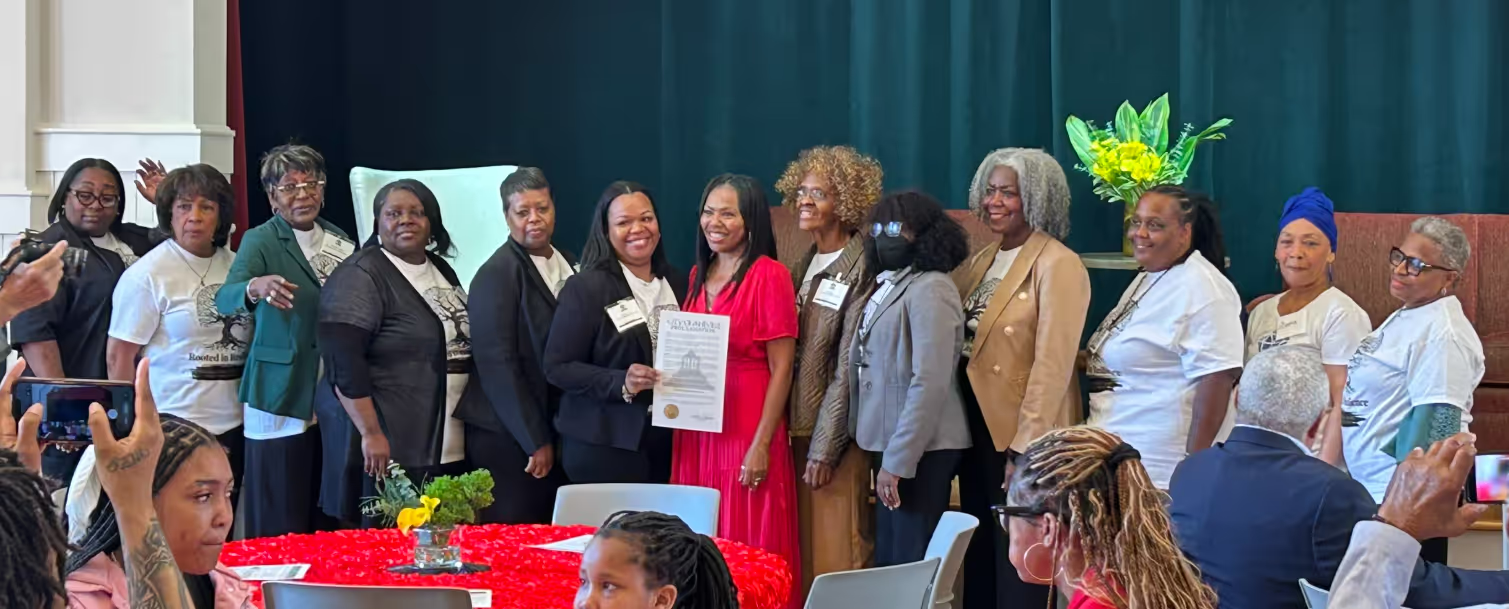
One of the most moving moments of the day came when Asheville Vice Mayor Antanette Mosley, Esq., a fifth-generation daughter of the city, presented a proclamation from the City of Asheville honoring the gathering and the women whose persistence made it possible. Standing together in their Rooted in Resilience shirts, the members of the Asheville Women's Support Group received official recognition of something the community already knew: their work matters, and it is seen.
And the day gave back in tangible ways. Generous donations from the Robeson County Disaster Recovery Coalition provided supply bags that went directly to community members still working toward recovery from Hurricane Helene — resilience made tangible, neighbor to neighbor.
In the weeks since, community members who organized and attended the event have continued to share reflections on what the day meant: the pride of seeing Asheville's Black community gathered in its most historic space, the relationships formed across organizations, and the renewed energy carried back into ongoing recovery work. For many, the gathering was not a conclusion to the healing that began after Helene — it was an amplification of it.
And for those who want to carry the day with them: Rooted in Resilience tees are available — contact Jasmine Moore at jasmine@gcpcusa.org to get yours.
The People Who Made It Possible
Rooted in Resilience was presented by the Asheville Women's Support Group in collaboration with the Black Resilience Network and the All Healers Mental Health Alliance, and offered free to the community thanks to the generous support of our Presenting Sponsor, the American Baptist Home Mission Societies, whose investment in Black communities, Black health, and Black resilience is felt deeply.
A twelve-member planning committee carried the event from vision to reality: Mrs. Cassandra Campbell, Mrs. Phyllis Cunningham-Boykin, Ms. Olympia Garrett, Ms. Johnnie N. Grant, Ms. Shuvonda Harper, Ms. Alice Jones, Mrs. Jasmine Moore, Ms. Priscilla Robinson, Ms. Inez Whiteside, Ms. Betty Young, Dr. Annelle Primm, and Dr. Atyia Martin — through every call, every meeting, every detail, and every act of love.
Support Our Vendors & Community Partners
One of the most powerful things we can do as a community is support the people who show up for us. Please visit their websites, follow them on social media, and make a purchase — every dollar invested in a Black-owned or community-aligned business is an investment in our collective resilience:
Black Resilience Network • ABIPA • All Healers Mental Health Alliance • Next Leadership Development • YMI Cultural Center • NAMI Western Carolina • NC A&T • Operation Gateway • Robeson County Disaster Recovery Coalition • Sistas Caring 4 Sistas • Southside Community Farm • The Plug Chiropractic • Urban News • Woman Strong & Brandy Mills Consulting • BEHOLD (Tymeka Whiteside) • Healed Skin & Candle Co. • E. NC Reg. Assoc. Black Social Workers • Red Angle Photography • Big Tyme Printers • Blue Crystal Wellness • Moore Courage Healing & Wellness • Priscilla Ann Robinson • The ENVOY Guide
This Is Just the Beginning
Asheville was the first stop in the Rooted in Resilience series — a declaration that Black resilience is not theoretical. It is practiced, it is celebrated, and it is unstoppable. The series will carry this model into communities across the country, season by season, city by city, asking the same question everywhere it lands: what does it look like when a community decides to root itself — in health, in wealth, in legacy, and in each other?
We are now connected. We are now rooted. This is just the beginning.
Go Deeper
Explore the full event recap, photos, and reports at nextleads.org/rooted-asheville.
📄 Asheville Event Report | 📋 Executive Summary | 📜 The 1526 Report
🎥 Watch: Historic Black Churches of Asheville Provide Community for Their Members — Watch on YouTube
📰 Read the Rooted in Resilience feature in The Urban News
Want Rooted in Resilience to come to your city? Join the conversation at the next BRN Member Meeting on Thursday, June 25, 2026, or reach out at brn@nextleads.org. Learn more about the Black Resilience Network at blackresiliencenetwork.org.